
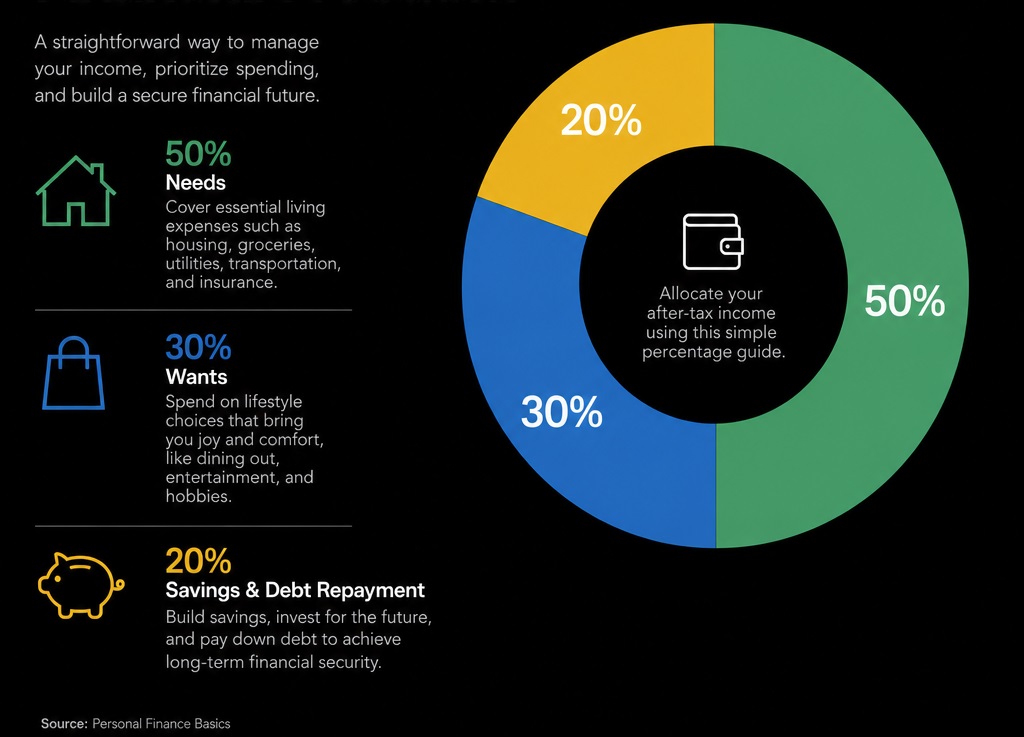
How the Rule Works
After-tax income (take-home pay after taxes and deductions) is the base. Divide it:
- 50% – Needs: Essentials required for survival and basic functioning. Rent/mortgage, utilities, groceries, transportation, minimum debt payments, insurance, childcare. If housing alone exceeds 50%, the rule signals a problem.
- 30% – Wants: Discretionary spending that improves quality of life but isn’t essential. Dining out, hobbies, vacations, streaming services, upgraded gadgets, gym memberships. This category funds enjoyment without guilt.
- 20% – Savings and Debt Repayment: Future-focused money. Retirement accounts (401k, IRA), emergency fund, extra debt payments beyond minimums, investments, education funds. This builds wealth and security.
The beauty is simplicity: no need to categorize every coffee. Adjust percentages slightly if your situation demands (e.g., 60/20/20 for high-cost cities), but keep the core structure.
Why It Works for Financial Freedom
Financial freedom means having enough savings and investments to live without relying on a paycheck. The 50/30/20 rule directly supports this by:
- Preventing lifestyle inflation: The 30% wants cap forces conscious spending. As income rises, you increase savings, not just spending.
- Building an emergency fund: The 20% savings bucket ensures you prioritize the 3–6 month cushion that prevents debt spirals.
- Accelerating debt payoff: Extra payments on credit cards or student loans fall into the 20% category, reducing interest drag.
- Creating investment habit: Regular contributions to retirement accounts compound over time. Even modest amounts grow significantly.
A study by the Federal Reserve found that nearly 40% of Americans would struggle to cover a $400 emergency. The 50/30/20 rule directly addresses this vulnerability.
Step-by-Step Implementation
- Calculate your after-tax income. Include salary, side hustles, child support. Exclude irregular bonuses unless you average them.
- List all expenses for one month. Use bank statements or apps like Mint or YNAB. Group into needs, wants, and savings.
- Compare actual spending to the 50/30/20 targets. Identify gaps.
- Adjust behavior:
– If needs exceed 50%, look for reductions: refinance mortgage, downsize car, negotiate insurance, use public transit.
– If wants exceed 30%, cut non-essential subscriptions, limit dining out, use the 24-hour rule for purchases over $50.
– If savings are below 20%, automate transfers on payday. Start small (10%) and increase gradually.
Common Pitfalls and How to Avoid Them
- Misclassifying needs as wants or vice versa: A car may be a need if required for work, but a luxury SUV is a want. Be honest. Groceries are needs; takeout is a want.
- Ignoring irregular expenses: Annual insurance premiums, car repairs, holiday gifts. Budget for them monthly by dividing by 12 and setting aside in a sinking fund.
- Using gross income instead of net: The rule uses after-tax income. Using gross inflates your needs percentage.
- Not adjusting for life changes: Job loss, marriage, children require recalibration. Review quarterly.
- Treating it as rigid: If you’re in debt, you might allocate 30% to debt and 20% to wants temporarily. Flexibility is allowed.
Variations for Different Situations
- High debt burden: Shift to 50/20/30 (needs/wants/debt+savings) until debt is under control.
- Low income: If needs consume 70%, focus on increasing income first. Use the rule as a target, not a failure.
- Retirees: Reverse the rule: 50% needs, 30% wants, 20% savings? Actually, retirees may have lower savings needs but higher healthcare costs. Adjust to 60/30/10 or use the 4% withdrawal rule.
- Freelancers: Irregular income makes it harder. Base on average of last 6 months, and build a larger emergency fund.
The Psychology Behind the Rule
Budgeting fails when it feels restrictive. The 50/30/20 rule succeeds because it gives permission to spend 30% on wants without guilt. This psychological buffer prevents burnout and crash dieting of finances. It also creates a clear visual: you can see progress toward freedom with each savings contribution.
Behavioral economists note that people who automate savings (part of the 20%) are more likely to achieve goals. The rule encourages automation: set up automatic transfers to savings and investment accounts on payday.
Real-World Example
Take-home pay: $4,000/month.
- Needs: $2,000. Rent $1,200, utilities $200, groceries $400, transport $150, insurance $50.
- Wants: $1,200. Dining out $300, hobbies $200, streaming $50, vacations $300, miscellaneous $350.
- Savings: $800. Roth IRA $500, emergency fund $200, extra debt payment $100.
After 12 months, emergency fund reaches $2,400. Debt decreases by $1,200. Retirement account grows. This person can handle a car repair without credit cards.
Tools and Resources
- Budgeting apps: Mint (free), YNAB (paid, but excellent for zero-based budgeting), EveryDollar (free version).
- Spreadsheets: Many free templates online. Search “50/30/20 budget spreadsheet”.
- Books: All Your Worth by Elizabeth Warren, The Total Money Makeover by Dave Ramsey (more aggressive debt focus).
- Online calculators: NerdWallet 50/30/20 calculator helps visualize.
Adapting for Financial Independence (FI)
For those pursuing early retirement (FIRE), the 20% savings rate may be too low. FIRE typically requires 50–70% savings. But the 50/30/20 rule still serves as a foundation: reduce wants further (e.g., 20% wants, 60% savings) while keeping needs at 50%. The framework adapts.
The key is starting. Even a 20% savings rate, if maintained early, can lead to financial freedom in 30–40 years. Combined with investment returns, it’s powerful.
Final Thoughts
The 50/30/20 rule is not a magic bullet but a sensible default. It provides structure without micromanagement, flexibility without chaos, and a clear path toward financial freedom. Start today: calculate your after-tax income, categorize your last month’s spending, and adjust until you hit the targets. Then automate and review quarterly.
Financial freedom isn’t about deprivation; it’s about intentional allocation. The 50/30/20 rule helps you spend on what matters, save for what’s next, and live well now.
For further reading, see The Simple Path to Wealth by JL Collins or The Little Book of Common Sense Investing by John Bogle.